
Folder views
A folder view replaces a folder’s widget grid with your own tree - a dashboard, a mixer, a monitoring panel.
Example
Section titled “Example”public sealed class MonitorIntegration : IPluginIntegration, IFolderViewProvider, IUiProvider{ private string? _dashboard;
public string ProviderName => "System monitor";
public async Task InitializeAsync(IFolderViewProviderContext context, CancellationToken cancellationToken = default) { var registration = await context.RegisterFolderViewAsync( new FolderViewDescriptor( "dashboard", MyStrings.DashboardName(), MyStrings.DashboardDescription(), HasConfiguration: true), cancellationToken);
_dashboard = registration.FolderViewId; // "com.example.monitor::dashboard" }
public IReadOnlyList<UiSurfaceDeclaration> Surfaces { get; } = [ new UiSurfaceDeclaration { Kind = UiSurfaceKinds.Folder, SessionMode = UiSessionModes.Shared }, new UiSurfaceDeclaration { Kind = UiSurfaceKinds.Config, SessionMode = UiSessionModes.Exclusive }, ];
public Task<IUiSession?> CreateSessionAsync(UiSessionRequest request, CancellationToken cancellationToken) { var surface = request.Surface; var attributes = surface.Attributes;
UiElement? root = surface.Kind switch { UiSurfaceKinds.Folder when attributes[UiFolderSurfaceAttributes.ViewId].GetString() == _dashboard => Dashboard(attributes[UiFolderSurfaceAttributes.Configuration]), UiSurfaceKinds.Config when attributes[UiConfigSurfaceAttributes.EntryPoint].GetString() == UiConfigEntryPoints.FolderViewConfig && attributes[UiConfigSurfaceAttributes.FolderViewId].GetString() == _dashboard => DashboardConfig(attributes[UiConfigSurfaceAttributes.FolderViewConfiguration]), _ => null, };
return Task.FromResult<IUiSession?>(root is null ? null : new ViewSession(new UiView(surface, root))); }
private static UiStack Dashboard(JsonElement configuration) => new() { Key = "dashboard", Direction = UiComponentDirections.Horizontal, Gap = 0.04, Padding = 0.04, Children = [ new UiClockDial { Key = "clock", Value = UiValue.Of(UiTimeReference.InZone("Europe/Berlin")), Fill = true }, Card("cpu", "CPU"), Card("gpu", "GPU"), ], };
// IPluginIntegration members, Card and DashboardConfig omitted.}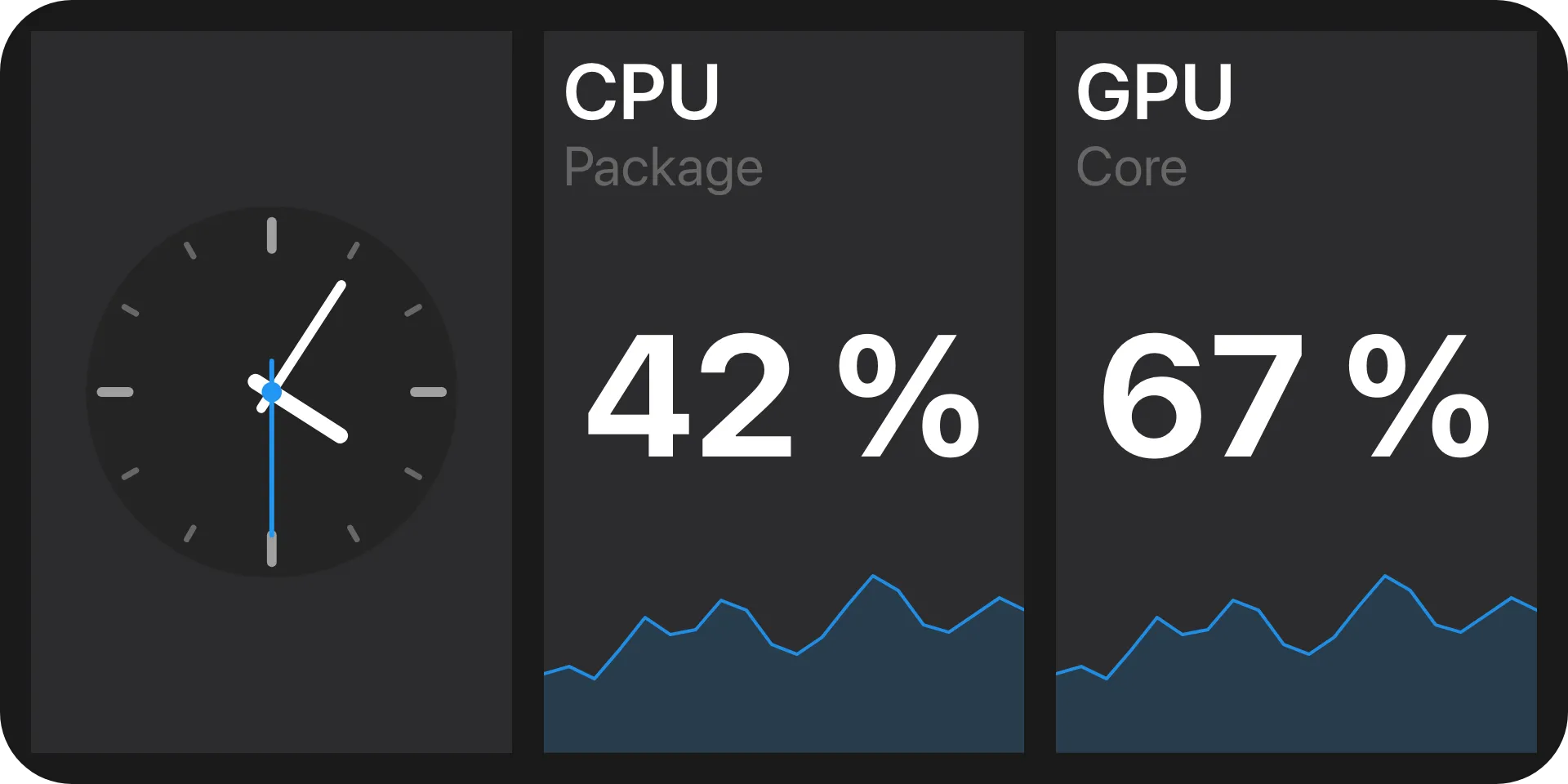
ViewSession is the adapter from Serving a view. A folder stays an ordinary
folder: its view is part of its configuration, picked like its name and changeable later without
touching anything else. Macro Deck’s built-in view is the widget grid.
Registering the view
Section titled “Registering the view”var registration = await context.RegisterFolderViewAsync(descriptor, cancellationToken);// registration.FolderViewId == "com.example.monitor::dashboard"The qualified id is what a folder stores. Keep it stable across releases - renaming it strands every folder already using the view.
Registration is a push: register when you are ready, withdraw when you are not. GetFolderViews() only
lets Macro Deck recover its catalog after a reconnect, and is optional. There is no ShutdownAsync here:
release what InitializeAsync acquired in your integration’s own ShutdownAsync, and Macro Deck
withdraws your views itself.
Drawing the folder
Section titled “Drawing the folder”var viewId = attributes[UiFolderSurfaceAttributes.ViewId].GetString();var configuration = attributes[UiFolderSurfaceAttributes.Configuration];A folder surface carries folderId, folderName, viewId and configuration. The configuration
travels with the request because you cannot read Macro Deck’s stored folders. Decline a view you do not
serve rather than guessing from the configuration’s shape.
The tree is built from the same components as a deck widget, with two consequences:
- A folder view does not scroll. Everything has to fit the box you are given.
- Lengths are fractions of the box’s smaller side. A folder view is usually far wider than tall, so sizes track its height - see Sizing.
Configuration
Section titled “Configuration”UiSurfaceKinds.Config when attributes[UiConfigSurfaceAttributes.EntryPoint].GetString() == UiConfigEntryPoints.FolderViewConfigWith HasConfiguration, picking your view opens a config surface with the folder-view-config entry
point, inside the folder’s own dialog rather than as a flow of its own. Build it with the
configuration view. It carries folderId, folderViewId and
folderViewConfiguration; folderViewId is the view being configured, which is not always the one the
folder currently stores - the user is choosing. The values are stored with the folder and handed back on
every later folder surface.
Navigation is Macro Deck’s
Section titled “Navigation is Macro Deck’s”new FolderViewDescriptor("mixer", "Mixer", Navigation: FolderViewNavigation.Hidden);Macro Deck draws the back button and it always drives Macro Deck’s own navigation stack - you cannot
redirect it and need not draw one. Hidden says your view has its own way out; it is a preference, not a
guarantee. Macro Deck still shows its button when the view is the only thing on screen and there is
somewhere to go back to, so a broken view can never trap anyone. At a root folder it draws no button,
whatever you asked for.
When your integration is not running
Section titled “When your integration is not running”await context.UnregisterFolderViewAsync("dashboard", cancellationToken);A folder keeps its view id and configuration whether or not anything provides them. Macro Deck renders a placeholder naming the missing view, with links to the integrations page and the folder’s settings. Nothing is cleared, so re-enabling your integration brings the folder back exactly as it was - including after an archive import on a machine without your plugin. Unregistering only stops the view being offered.
Where a folder view can be chosen
Section titled “Where a folder view can be chosen”The choice appears - in a folder’s context menu and when creating one - only when more than one view is on
offer and the device claiming the profile can render one (LayoutVisualCapabilities.CustomFolderViews, see
Layout providers). A profile no device claims keeps the choice. So a registered view
may not be an option on some profile; nothing selects it there, so nothing opens a session for it.
Over the plugin protocol
Section titled “Over the plugin protocol”Registration is driven from the plugin side, so the host-to-provider direction of the
folder-view-provider capability only has to describe the provider and re-read its catalog after a
reconnect:
| Operation | Purpose |
|---|---|
describe |
The provider’s declared name and its current catalog. |
folder-views |
The provider’s current folder view catalog, re-read after a reconnect. |
Registering and withdrawing a view travels the other way as the folder-views host API:
| Operation | Purpose |
|---|---|
register |
Registers a folder view, or replaces one already registered under the same provider-local id. |
unregister |
Withdraws a folder view. Folders still using it keep their stored id and configuration and show a placeholder until it returns. |
The views themselves are served over the ui capability, like every other Macro Deck UI surface.
See also
Section titled “See also”- Widget types - the same registration shape, one level down.
- Layout providers
- Serving a view
- Components